
-
 [1]
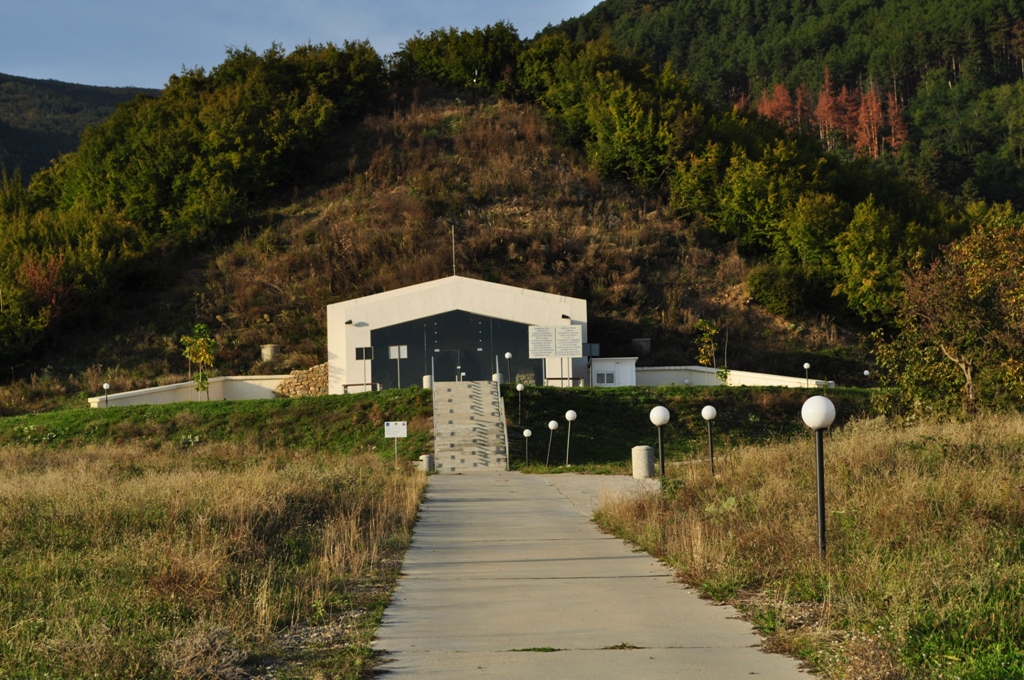
The Thracian mound – Shushmanets was discovered on 28-th of August 1996. It has a wide corridor which rather looks like a yard, antechamber with a half-cylindrical arch and a round chamber with a dome cover. Few are the Thracian temples for which with more correctness and more allowing no appeal could be used the definitions ‘one of its kind’ and ‘best’. It for a first time and in an unique way combines half-cylindrical and domed covering, for a first time an in a unique way offers pillar support of the anteroom and of the chamber.
The floors of the anteroom and chamber are covered with lime putty, walls and pillars – too. In the anteroom were sacrificed 4 horses and 2 dogs found in an anatomical line. The entrance for the round premise was closed by a two-leaved stone door with cassette surface, images of strongly stylized ‘rotating sun discs’ which were later covered under a thick layer of red paint. Above the entrance to the central premise was shaped a fake fountain with palmette and half-palmettes in the corners. The pillar in the central chamber is shining white and ends with a big disc which with no doubts symbolizes the sun. Even more that under it come out 15 radially positioned stone slabs – sun beams which outline the sky as well as the sunny, heavenly world which it represents. Two more horizontal zones are connected with the symbolism of the Thracian religion and the concepts of the Thracians for the structure of the world. The holy numbers for the Thracians are 3, 7, 10. Walls of the chambers are divided into three zones located one above the others. They symbolize consecutively the underworld, the earthly world and the heavenly world. The lowest zone is vertical. Through seven pillars, it is divided into seven vertical zones. Each of the semi-pillars has ten longitudinal flutes.
The temple in mound Shushmanets, as well as almost all other without the one in Sashova mogila, was discovered without significant archeological materials. The only whole object was an iron pruning-knife left near the entrance. The exclusive scientific and artistic value of the temple is in the architecture and in the demonstrated philosophic and religious concepts. The plundering or the ritual emptying of the round chamber and the untouched preservation of the four horses and two dogs collide and is hard to be explained.
The temple was restored and socialized and expects its visitors.
Contacts:
The temple is situated near the town of Shipka, municipality of Kazanlak.
Historical museum ‘Iskra’, town of Kazanlak, phone: +359 431/62755
e-mail: museum.iskra.kz@abv.bg [2]